



James battles Father Time! Data analysis reveals this season's changes: Is he incompatible with Doncic and Reeves?



On December 19th Beijing time, nearly 41-year-old James continues his fight against Father Time. ESPN’s in-depth data article analyzes James’s changes this season and examines how well he fits with Lakers stars Doncic and Reeves. Here is the detailed breakdown —
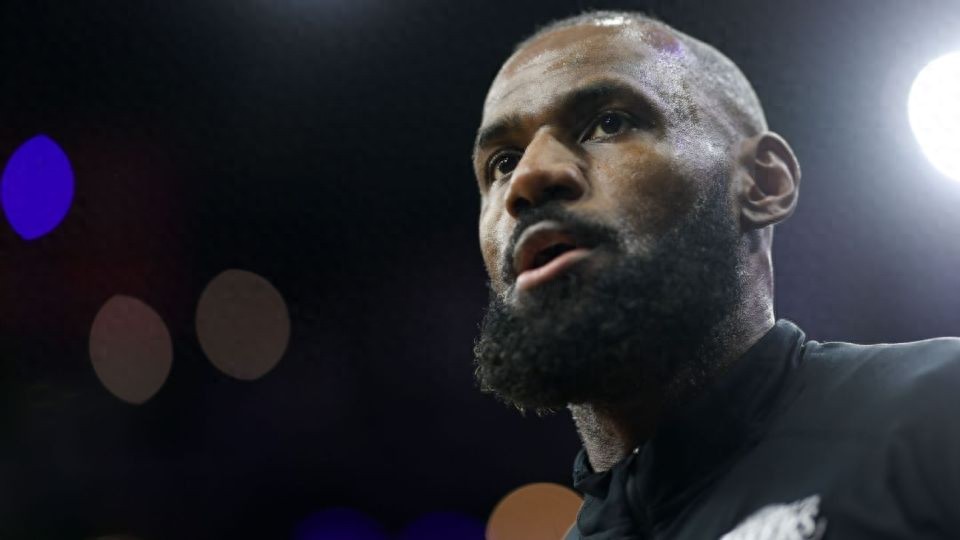

The 2025-26 season James is unlike any phase of his career before. Sciatic nerve pain forced him to miss the season opener for the first time in his career. After sitting out the Lakers’ first 14 games, his performance has shown unprecedented volatility, and his playing style has clearly shifted.
With only 12 days left until his 41st birthday, this once nearly “ageless legend” finally shows signs of weariness.Meanwhile, on the 18-7 Lakers, he has increasingly stepped back to a secondary role, handing more leadership responsibilities to teammates Doncic and Reeves.
Let’s explore how this season’s James differs from the past two decades — and what it means for the Lakers aiming to break through the fiercely competitive Western Conference. After all, if this team wants to contend for the championship, this future Hall of Famer must regain elite form.
Scoring king’s decline in points
For almost any other player in NBA history, competing beyond age 40 is extraordinary, and averaging 17.6 points is unprecedented. Previously, the only legendary player to remain scoring-competitive at age 41 was Kareem Abdul-Jabbar, who averaged 10.1 points that season, a decline marking the twilight of his long career. His last season averaging over 24 points was at age 33.
In contrast, James has averaged at least 25 points per game for 20 consecutive seasons since his rookie year, only slightly dipping to 24.4 points last season.
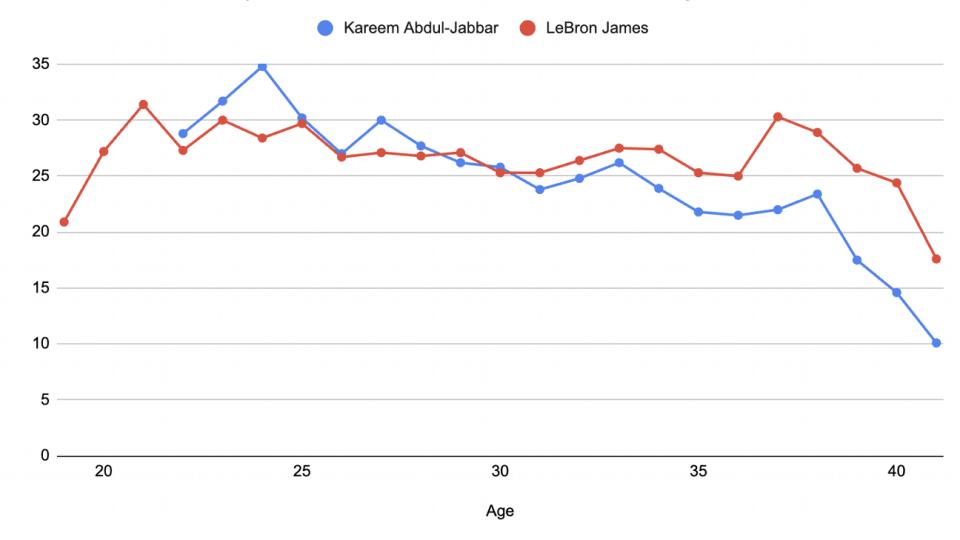
This remarkable longevity and consistency helped James surpass Jabbar to top the all-time scoring list. Although Jabbar had higher scoring efficiency during their peak years, James entered the NBA straight from high school, starting his career earlier and maintaining a high level — until this season.
James’s scoring average has dropped by 6.8 points per game compared to last season, the largest decline among all 47 players who averaged 20+ points last year.(Meanwhile, Reeves’s scoring average increased by 7.6 points, also the highest rise among last season’s 20+ point scorers.)
Much of James’s scoring drop stems from a significant loss of his trademark consistency. This season he has only scored 20+ points in 3 games, while also posting low outputs of 13, 11, 10, and even 8 points in single games. That 8-point game ended his record streak of 1,297 consecutive regular-season games scoring in double digits.
Generally, a player’s scoring depends on both efficiency and shot volume — James’s decline is due to decreases in both. Genius IQ data considers shot distance and defender positioning to estimate each player’s “expected effective field goal percentage.” Since the 2013-14 tracking era began, James’s actual effective field goal percentage has always exceeded expectations.
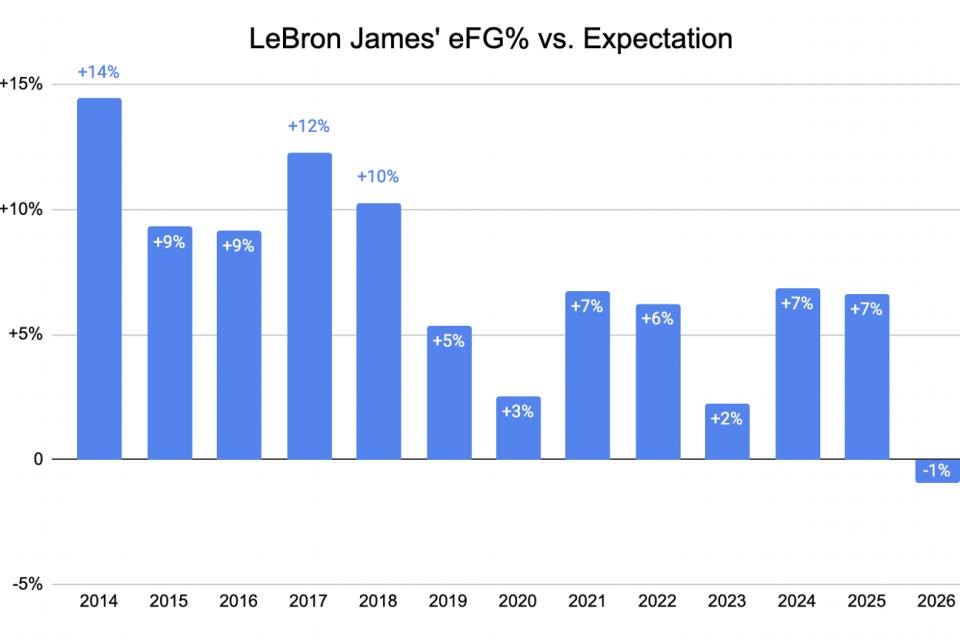
However, in the 2025-26 season, his actual shooting efficiency slightly fell below expected for the first time.
A completely different playing style
Besides efficiency dropping, James’s scoring opportunities have also diminished. In all previous seasons, his usage rate never fell below 28%, consistently ranking among the league’s top 12 for 20 seasons. In his 21st and 22nd seasons, this slipped slightly to 21st and 14th respectively.
But in his 23rd season, if meeting minimum minutes, his 24.2% usage rate ranks only 47th in the league. Last season, he was still on par with superstars like Mitchell, Wembanyama, and Curry; now, he ranks alongside secondary stars like Jerami Grant, Jaren Jackson Jr., and Derrick White.

James has never led his team’s offense so little as now. The specific data is as follows:
According to Genius IQ, James’s ball-handling time per 100 possessions is only 4.32 minutes, down from his previous low of 7.23 minutes in the tracking era, and 7.56 minutes last season. This decline ranks second among all rotation players this season (the largest drop belongs to Herro, who plays a different role in Miami’s new offense).
His drives per 100 possessions dropped from 14.5 last season to 8.0, previously his lowest was 11.3.
His isolation plays per 100 possessions fell from 11.4 last season to 7.1, whereas his career low before was never below 9.1.
As ball-handler, his pick-and-roll attempts per 100 possessions plunged from 26.2 last season to 10.7, a 59% decrease.
James’s offensive data trends are highly consistent across all categories. Essentially, every usage metric’s trendline shows:
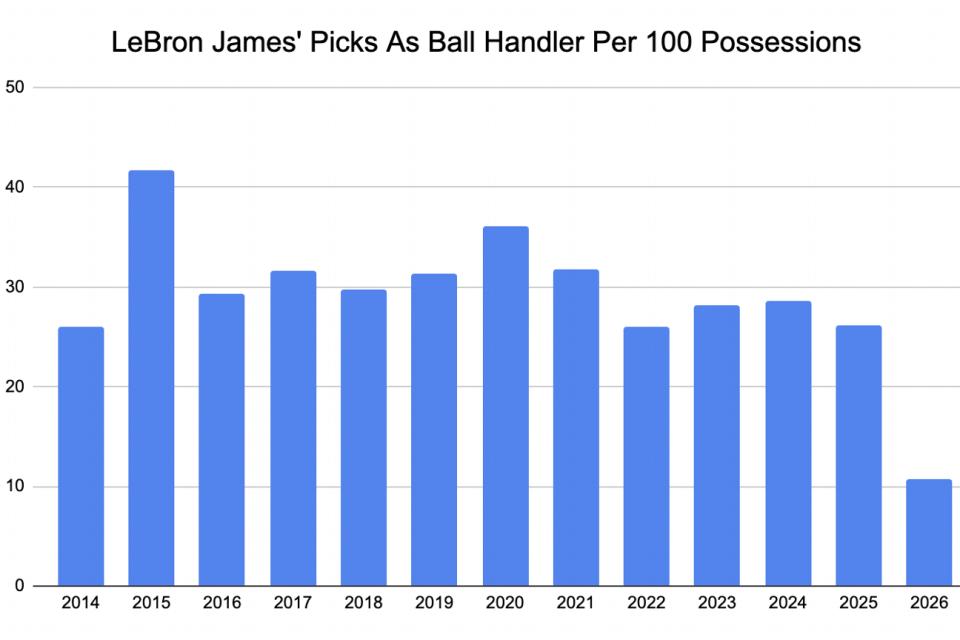
From the start of tracking data until last season, his stats fluctuated slightly year-to-year but remained extremely stable — especially considering his age increased from 29 to 40 during this period. But in 2025-26, all metrics plummeted dramatically.
Notably, when James truly leads the offense, his efficiency remains high. His isolation scoring efficiency ranks in the top 17% league-wide, and pick-and-roll scoring efficiency is top 8%. He simply attacks less frequently, instead choosing his moments more wisely than ever.
Outlook for James’s remaining 2025-26 season
What does the transformed James mean for himself and the Lakers’ remaining season? Has this star, long seeming to defy aging, finally surrendered to time?
The good news for James is that his shooting likely will improve as the season progresses— even if he cannot fully regain the peak level he maintained for decades. His true shooting percentage this season is only 53.9%, which if sustained would be his lowest since his rookie year. However, season-long stats often mask short-term fluctuations. Over the past decade, James has had nine stretches of multiple games with true shooting below this season’s current level, occurring during:
March 2025
November-December 2024
December 2023-January 2024
October-November 2022
December 2019-January 2020
January-February 2018
February 2016
December 2015
After each such slump, he successfully rebounded and completed his season campaign— including three times leading his team to the Finals afterward. Despite unprecedented age and injury challenges now, there is no reason to doubt he can rediscover form in the coming months.
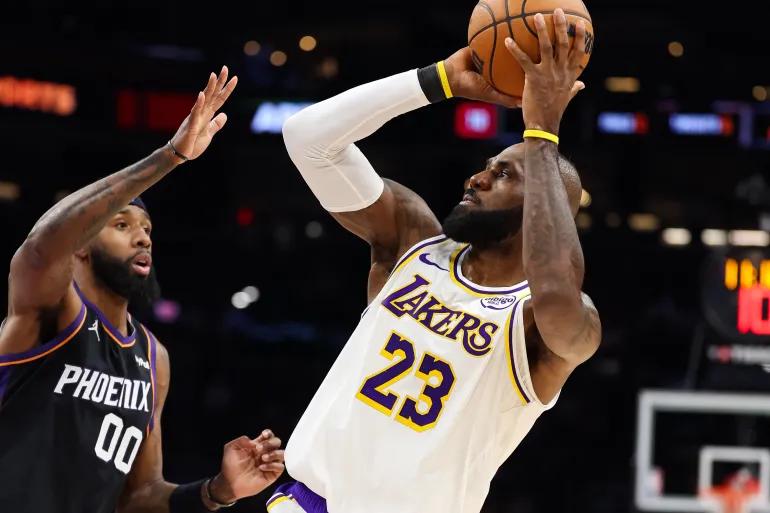
For example, James’s free throw percentage has dropped to a career-low 62% this season. In a game against the Phoenix Suns, he missed two technical free throws (though late in the game, after a three-point foul, he made two of three free throws to help secure a narrow win). For a player with over 11,000 career free throws made at 74% accuracy, such a sudden severe struggle is highly unusual and likely a short-term issue.
His three-point shooting percentage is also only 29%, whereas over the past five seasons it has consistently been around 37%. Considering his mid-range jump shot remains strong this season, such a sudden and sharp decline in three-point accuracy likely won’t last long.Advanced posture data from Genius IQ shows no clear abnormalities in James’s physical metrics, indicating his leg strength has not deteriorated enough to affect his long-range shooting touch.
However, even if James’s on-court performance rebounds toward his career average, his playing style may have undergone a permanent transformation.
Usage rates and offensive patterns tend to be “sticky” — statistically, trends seen early in the season usually persist throughout. In other words, we should no longer expect James to frequently drive, isolate, or initiate dozens of pick-and-rolls per game like in the past.
Another data point confirms this: among nearly 1,000 games recorded in the Genius IQ database, James has only had five games with fewer than 5 pick-and-roll attempts. One was in November 2013, another in the 2023 playoffs, and the other three occurred this season.
This is no coincidence but represents James’s “new normal.”
James’s impact on the Lakers
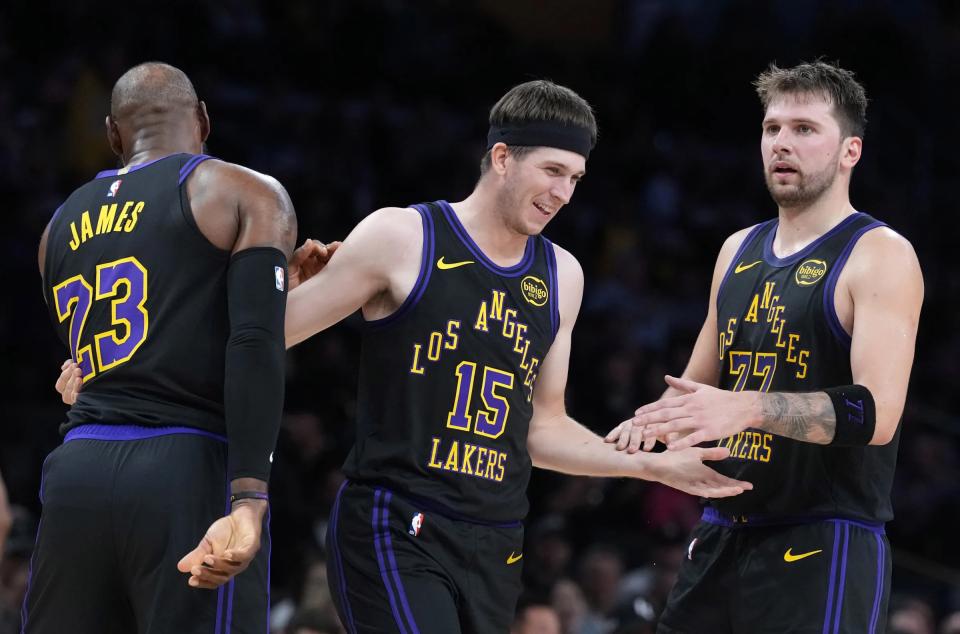
Another strong indicator of James’s current role and status is the Lakers coaching staff’s deployment of him. One dataset reveals that in games where James, Doncic, and Reeves all play, James has never been on the court alone even for a minute; whenever he plays, at least one of Doncic or Reeves is alongside him. According to PBP Stats, the minutes distribution across these 7 games is:
Doncic, James, Reeves: 132 minutes
Doncic, Reeves: 69 minutes
James, Reeves: 58 minutes
Doncic, James: 42 minutes
Doncic alone: 22 minutes
None of the three: 10 minutes
Reeves alone: 3 minutes
James alone: 0 minutes
Lakers coach Reddick’s rotation strategy makes sense: he wants at least two of the “big three” on the floor at all times. In fact, these lineup combinations account for 90% of total minutes in those 7 games. (The 10 minutes with none of the big three were all during garbage time after the outcome was decided.)
Last season, after acquiring Doncic midseason, Reddick often staggered Doncic and James’s minutes. In 2024-25 games where all three played, James had 55 minutes alone on the court.
But this season, Reddick staggered Doncic and Reeves instead of James. Considering Reeves’s star-level performance this season and the desire not to overburden nearly 41-year-old James, this adjustment is logical but clearly signals James’s changed role in the Lakers’ offense.
The biggest concern for the Lakers is that their “big three” have not shown the expected impact. This season, when James, Doncic, and Reeves share the court for 132 minutes, the Lakers have been outscored by 10 points.
This decline actually began earlier. In the 2024-25 regular season, these three combined for only a 2-point net advantage in 423 minutes together. In the playoffs, the Lakers suffered heavy losses, going 0-5 against the Minnesota Timberwolves with a 24-point net deficit when the trio played together.
Overall, the James-Doncic-Reeves trio has been outscored by 32 points over 695 combined minutes, with a net rating of -2.2 according to Cleaning the Glass. Their synergy has fallen far short of the expected 1+1+1>3 effect.
When these three offense-focused stars play together, the Lakers’ defense unsurprisingly suffers major issues. Cleaning the Glass data shows that in those 695 minutes, the Lakers’ defensive rating was 120.5, near the worst in the entire league.
The offense also raises concerns. The trio was assembled to create a dominant offensive system leveraging Doncic, James, and Reeves to offset defensive weaknesses. Yet, when all three are on court, the team’s offensive rating is only 118.3 — decent but far from dominant, comparable to the ninth-ranked San Antonio Spurs this season.
For comparison, consider another famous trio: in 2020-21, the Brooklyn Nets’ Durant, Harden, and Irving posted an astonishing 129.5 offensive rating in limited shared minutes, over 10 percentage points higher than the Lakers’ big three.
We can also look at Doncic and Reeves’s performance without James: in 585 minutes together, the team’s net rating was a strong +15.3 with an offensive rating of 122.9. Despite struggles in last season’s playoffs, this duo has been nearly unstoppable in the current regular season when James is off the court.
Therefore, the Lakers’ core issue is not simply that James is showing age. The real problem is that the combination of James, Doncic, and Reeves has failed to develop the chemistry necessary to compete with the Western Conference’s elite teams.


Wonderfulshortvideo
Luka & LeBron led the @Lakers to a win, combining for 73-pts on the night 🤩


LaMelo Ball had an amazing game tonight 💫
These two went off tonight 🐝
LaMelo is back in action 🐝
That pass was ridiculous 👀
LAMELO CALLED GAME 🥶
“Off the launching pad!” 🤯
 Links
Links
 Contact
Address:UNIT 1804 SOUTH BANK TOWER, 55 UPPER GROUND,LONDON ENGLAND SE1 9E
Number:+85259695367
E-mali:[email protected]
 App
App


