



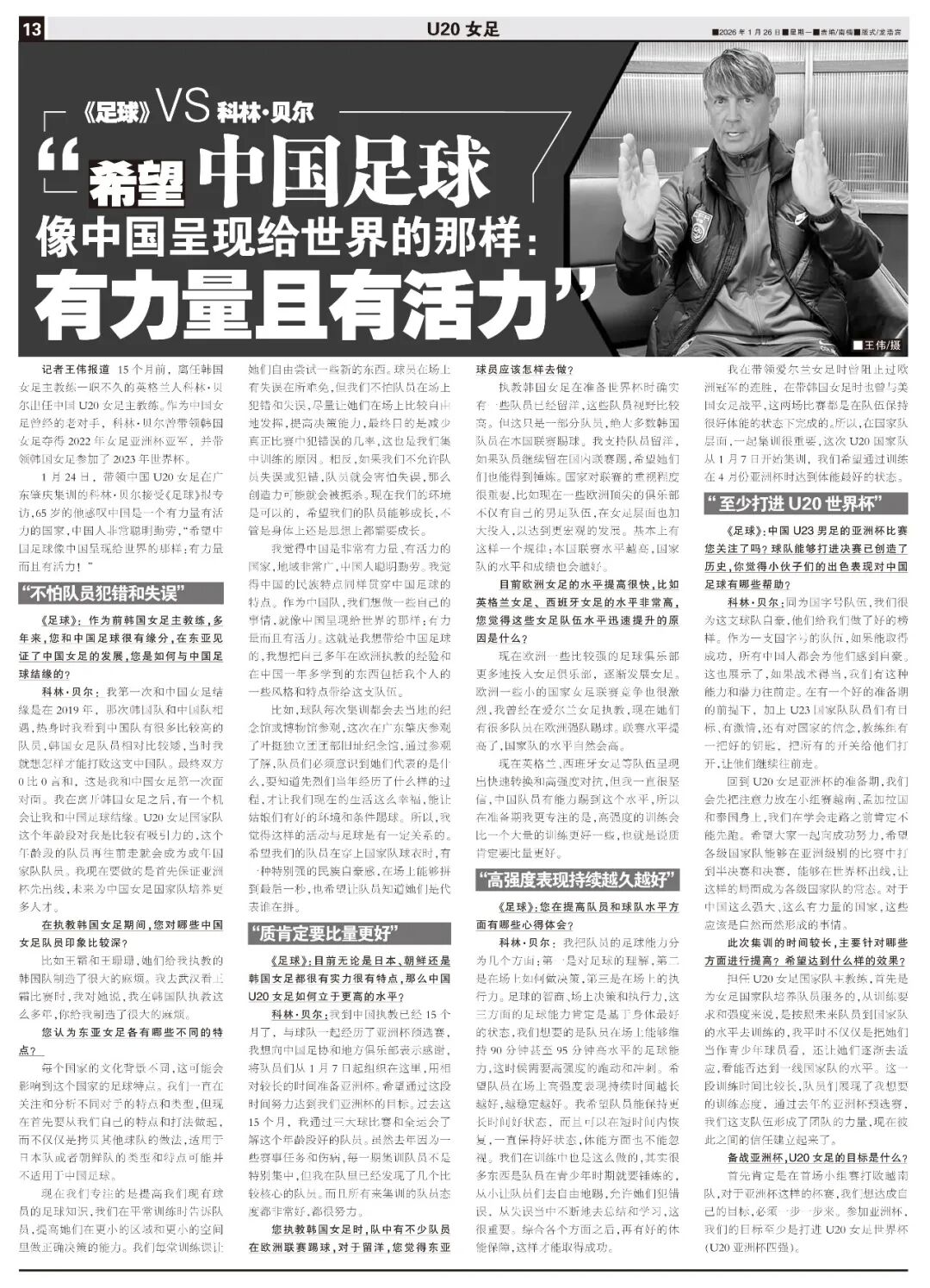
Colin Bell: I hope Chinese football embodies the strength and vitality that China presents to the world.



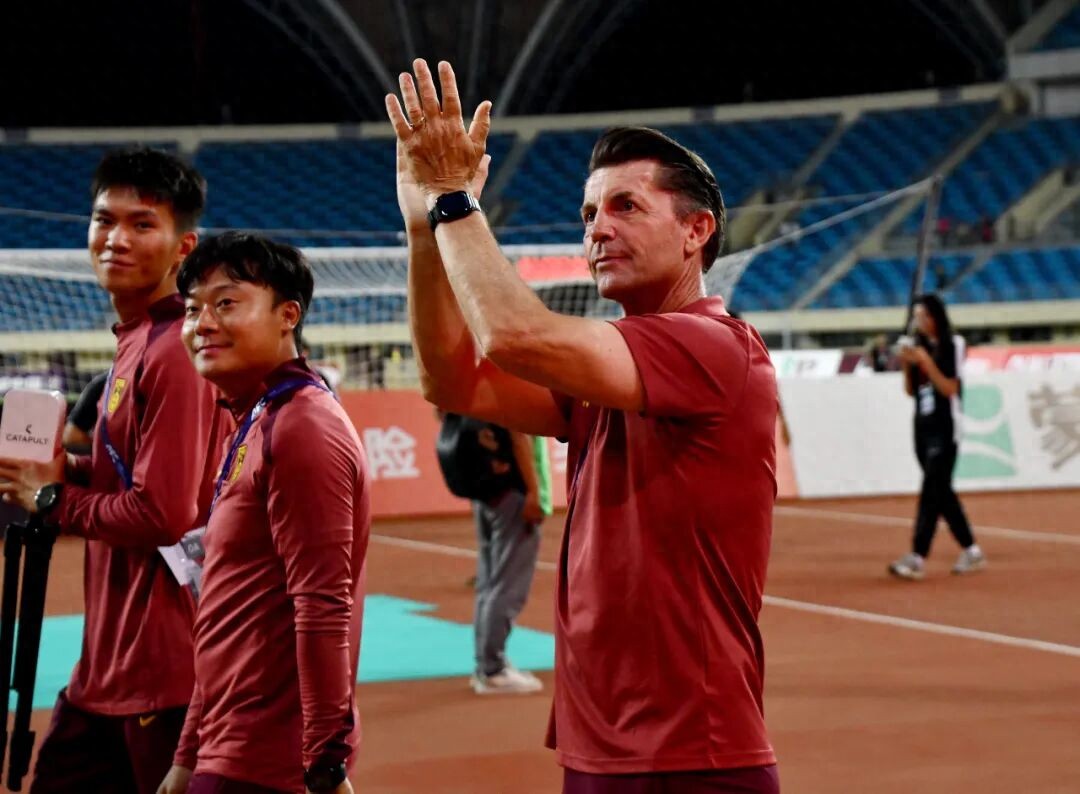
Reporter Wang Wei reports Fifteen months ago, shortly after leaving his post as head coach of the South Korean women's team, Englishman Colin Bell was appointed head coach of China's U20 women's football team. Having been a former adversary of the Chinese women's team, Bell led South Korea to second place in the 2022 Women's Asian Cup and took them to the 2023 World Cup.
On January 24, Colin Bell, who is leading the China U20 women's team in training at Zhaoqing, Guangdong, gave an exclusive interview to "Football" newspaper. At 65 years old, he expressed admiration for China as a powerful and vibrant country, saying, "I hope Chinese football can be as strong and energetic as China presents itself to the world!"

◆ "Football": As a former head coach of the South Korean women's team, you have had a long connection with Chinese football and witnessed the development of the Chinese women's team in East Asia. How did your relationship with Chinese football begin?
Colin Bell: My first encounter with the Chinese women's team was in 2019 when South Korea played against China. During the warm-up, I noticed China had many taller players, while the South Korean players were relatively shorter. I immediately wondered how to defeat this Chinese team. The match ended in a 0-0 draw, marking my first face-to-face experience with the Chinese women's team. After leaving the South Korean team, I had the opportunity to connect with Chinese football. The U20 women's national team age group is quite appealing to me because players at this stage are on the path to becoming senior national team members. My current goal is to first ensure qualification from the Asian Cup and in the future cultivate more talent for the Chinese women's national team.
◆During your time coaching the South Korean women's team, which Chinese players left a strong impression on you?
Players like Wang Shuang and Wang Shanshan caused significant challenges for my South Korean team. When I went to Wuhan to watch Wang Shuang play, I told her that after coaching the South Korean team for many years, she had given me a lot of trouble.
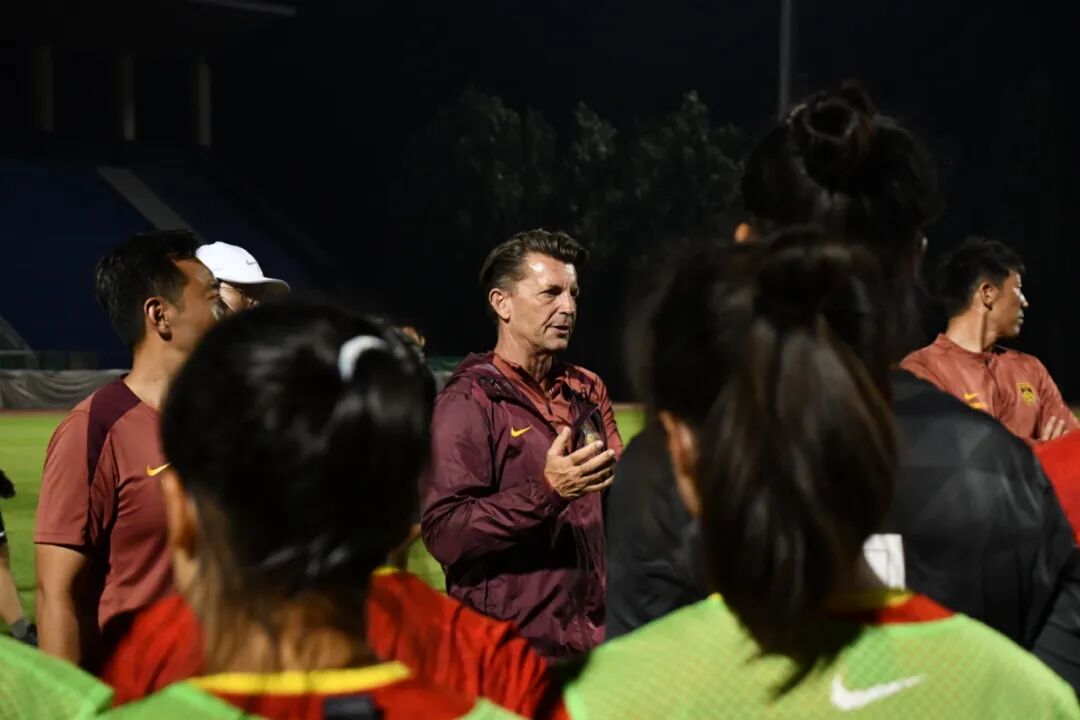
◆What differences do you see among East Asian women's football teams?
Each country has a different cultural background, which may influence their football style. We have always focused on analyzing the characteristics and styles of different opponents, but right now, we need to start with our own traits and playing style rather than simply copying others. The styles and strengths that work for Japan or North Korea may not suit Chinese football.
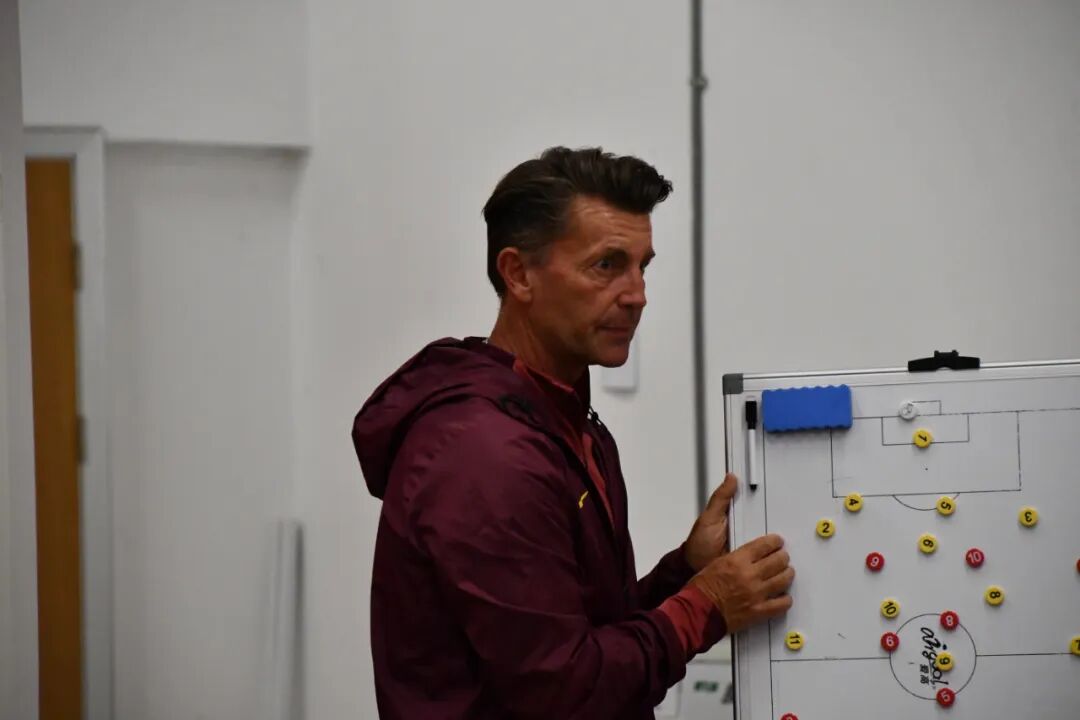
Currently, we focus on enhancing our players' football intelligence. During training, we emphasize improving their ability to make correct decisions in smaller spaces and tighter areas. We encourage players to freely try new things in every session. Mistakes on the field are inevitable, but we do not fear errors; instead, we want players to express themselves freely to develop decision-making skills. The ultimate goal is to reduce errors in real matches, which is why we concentrate on this type of training. Conversely, if players are not allowed to make mistakes, they become afraid, and creativity can be stifled. The environment we have now is supportive, and we hope our players grow both physically and mentally.
I believe China is a very strong and vibrant country with vast territory, and its people are smart and hardworking. I think the national character also permeates Chinese football. As the Chinese team, we want to do something unique, just like how China presents itself to the world: strong and vibrant. This is what I want to bring to Chinese football — combining my years of coaching experience in Europe with what I have learned in China over the past year, along with my personal style and characteristics, to benefit this team.
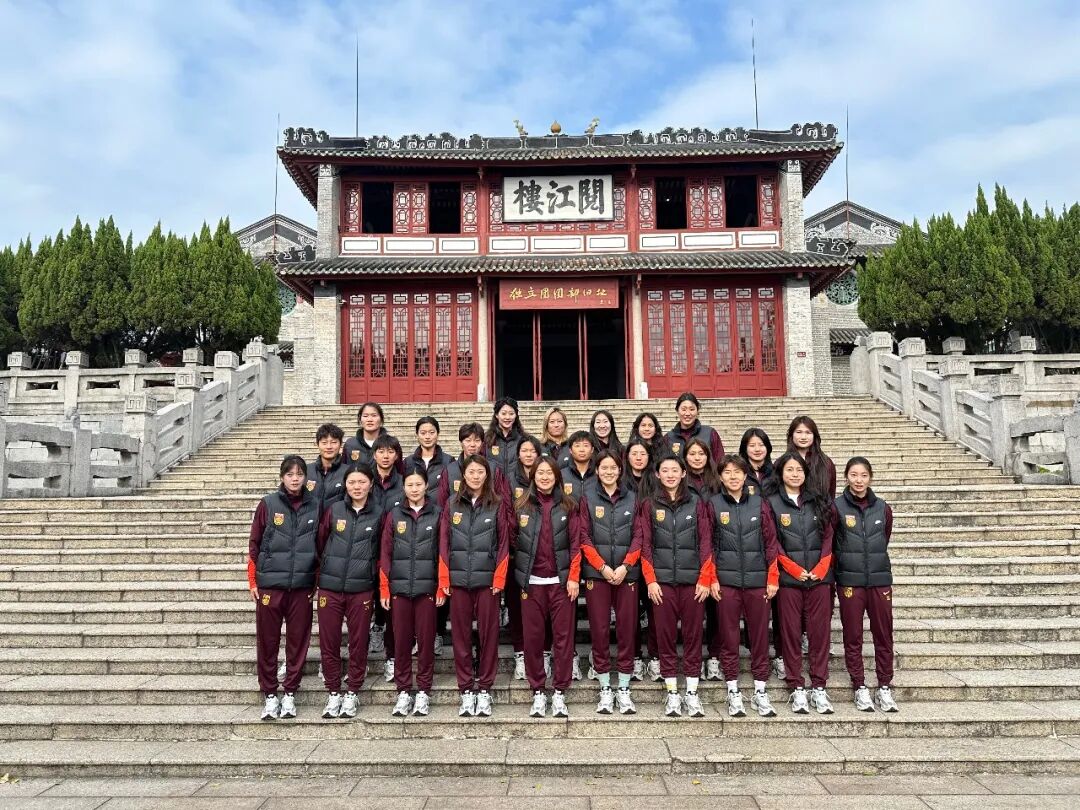
For example, each training camp, the team visits local memorial halls or museums. This time in Zhaoqing, Guangdong, they visited the former site of the Ye Ting Independent Regiment headquarters. By visiting, the players must realize what they represent and understand the hardships endured by the pioneers, which have allowed them to enjoy such favorable conditions for playing football today. So, I believe these activities relate to football. I hope when our players wear the national team jersey, they feel a strong sense of national pride, fight until the last second on the field, and understand who they are representing.

◆"Football": Currently, Japan, North Korea, and South Korea women's teams are all strong and distinctive. How can the Chinese U20 women's team elevate to a higher level?
Colin Bell: I have been coaching in China for 15 months and experienced the Asian Cup qualifiers with the team. I want to thank the Chinese Football Association and local clubs for organizing the players here from January 7, giving us relatively long preparation time for the Asian Cup. We hope to achieve our goals through this period of hard work. Over the past 15 months, I have identified some key players through major ball games and the National Games despite some challenges with scheduling and injuries last year, which meant not all players could attend every training camp. However, every player who came showed an excellent attitude and worked very hard.
◆When you coached the South Korean women's team, many players competed in European leagues. What is your view on East Asian players going abroad?
Indeed, when preparing for the World Cup with South Korea, some players were already playing overseas, which broadened their horizons. But that was only a portion of the squad; most players competed in the domestic league. I support players going abroad, but if they stay in the domestic league, I hope they can still be well trained. The national focus on the league's quality is crucial. For example, some top European clubs not only invest in their men's teams but are also increasing investment in women's football for broader development. Generally, the higher the level of the domestic league, the better the national team's performance and results.
◆The level of European women's football has risen rapidly, especially in England and Spain. What do you think accounts for the rapid improvement of these teams?
Currently, many strong European football clubs invest more in their women's teams, gradually developing women's football. Even smaller European countries have highly competitive women's leagues. I previously coached in Ireland, where many players now play for strong European clubs. As the league level improves, the national team's level naturally rises.
Teams like England and Spain now play with fast transitions and high-intensity confrontations. I firmly believe Chinese players can reach this level. Therefore, during preparation, I focus more on high-intensity training rather than just a large volume of training. In other words, quality definitely outweighs quantity.


◆"Football": What insights do you have about improving players and the team's level?
Colin Bell: I divide players' football abilities into several aspects: first, understanding of football; second, decision-making on the field; third, execution on the field. Football IQ, decision-making, and execution are all based on the best physical condition. We want players to maintain a high level of football performance for 90 to 95 minutes, which requires high-intensity running and sprinting. I hope players can sustain high-intensity performance for as long and as steadily as possible.
I want players to maintain good form for longer periods and recover quickly to keep performing well. Fitness is also critical. We train accordingly. Many of these skills must be developed during youth, allowing players to play freely, make mistakes, and learn from them, which is very important. Combining all these aspects with good fitness support is how success is achieved.
When I coached the Irish women's team, we stopped the European champions' winning streak, and with South Korea, we drew with the U.S. women's team. Both matches were played with the team in excellent physical condition. Therefore, at the national team level, training together is important. This U20 national team has been training since January 7, and we aim to reach peak fitness by the Asian Cup in April.

◆"Football": Have you followed the Chinese U23 men's team's Asian Cup? The team made history by reaching the final. How do you think their outstanding performance benefits Chinese football?
Colin Bell: As fellow national teams, we are very proud of them; they set a great example for us. When a national team succeeds, all Chinese people feel proud. This also shows that with the right tactics, we have the ability and potential to progress. Given good preparation time, plus the U23 players' goals, passion, and belief in their country, and a coaching staff with the right approach to unlock their potential, they can keep moving forward.
Returning to the U20 women's Asian Cup preparation, we will focus first on the group stage opponents: Vietnam, Bangladesh, and Thailand. We must learn to walk before we run. I hope everyone works together toward success. I wish all national teams at every level can reach semifinals and finals in Asian competitions and qualify for the World Cup, making this a regular achievement. For a strong and powerful country like China, this should naturally happen.
◆This training camp is relatively long. What areas are you focusing on improving, and what results do you hope to achieve?
As head coach of the U20 women's national team, my primary goal is to serve the senior women's national team by developing players. The training demands and intensity are aligned with the level expected for future national team players. I don't just treat them as youth players but help them gradually adapt to see if they can reach the first-tier national team level. This extended training period has shown me the attitude I want from the players. Through last year's Asian Cup qualifiers, our team has developed a strong collective spirit, and trust among players has been established.
◆What is the U20 women's team's goal for the Asian Cup?
First and foremost, we aim to defeat Vietnam in the opening group match. For a tournament like the Asian Cup, we must achieve our goals step by step. Our objective is at least to qualify for the U20 Women's World Cup by reaching the semifinals of the U20 Asian Cup.


Wonderfulshortvideo
The footwork, the finish 🤌


Did you get it? 🤔😅
The Wirtz x Sané link-up 🔗
Haaland’s movement 🥵
Which counterattack is
When you use your girlfriends shower 🚿 @Emily Bourne @LUSH
When Diogo Costa made himself a hero 🧤
 Links
Links
 Contact
Address:UNIT 1804 SOUTH BANK TOWER, 55 UPPER GROUND,LONDON ENGLAND SE1 9E
Number:+85259695367
E-mali:[email protected]
 App
App


