



Not Real Madrid, Supercomputer Points Directly to Champions League Champion



The 2.8% chance of winning for Real Madrid, the club with the richest history in the Champions League, has sparked much debate. However, within the mathematical context of the knockout format, this is not necessarily an underestimation, but rather the logical outcome of cumulative probability.
According to the latest forecast table from Opta (updated 27/02), Real Madrid has only a 35.6% chance of reaching the quarter-finals, 11.1% for the semi-finals, 6% for the final, and 2.8% of lifting the trophy. In contrast, teams ranked higher such as Arsenal (27.4%), Bayern Munich (14.3%), or Liverpool (12.8%) all possess superior probabilities. This reflects the reality that Real Madrid is not considered dominant in the round of 16.
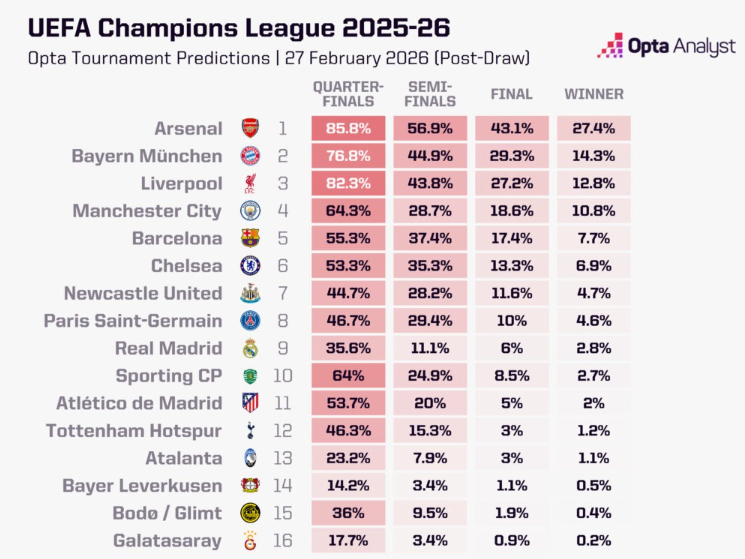
Another crucial factor is the tournament bracket. According to Opta, the Real Madrid – Manchester City pairing continues a classic rivalry. This is the fifth consecutive season the two clubs have met in the Champions League knockout stages – a record in the competition's history.
Manchester City is rated with a 64.3% chance of advancing from this tie and a 10.8% chance of winning the entire tournament. Conversely, Real Madrid, despite having beaten City in many key moments in the past, is still ranked only ninth in terms of title chances.
When facing an opponent like City right from the round of 16, Real Madrid's overall probability is naturally pulled down significantly. In probability models, the tournament bracket directly influences the final odds. Clearly, Real Madrid's bracket, featuring the likes of Man City, PSG, and Bayern Munich, is rated as much more difficult.

Furthermore, the algorithms favor teams with stable offensive and defensive efficiency, creating many clear-cut chances (high xG), and minimizing errors. Arsenal, Bayern, or Liverpool are highly rated because they maintained superior statistical foundations throughout the group stage.
Real Madrid, on the other hand, does not always dominate opponents statistically. They often win through resilience, moments of individual brilliance, and the ability to seize opportunities in decisive moments. This represents immense tactical and psychological value, but it is difficult to fully quantify within a mathematical model.
The Champions League has always been a tournament of variables. A red card, a penalty, or a shootout can completely overturn the situation. Teams with high volatility in their play, while dangerous, also imply higher risk in probability calculations.

The 2.8% figure merely reflects the data at the moment of simulation, not a definitive statement on the outcome. Historically, Real Madrid has entered knockout stages many times without being seen as the top contender, yet still ended the season with the silverware.
In the Champions League, there always exists a gap between probability and reality. Data can be cold, but football has never been decided by calculation alone.
For Real Madrid, 2.8% is simply a number. And in an arena where tradition, experience, and decisive moments determine fate, all predictions can be challenged when the true European nights begin.



 Links
Links
 Contact
Address:UNIT 1804 SOUTH BANK TOWER, 55 UPPER GROUND,LONDON ENGLAND SE1 9E
Number:+85259695367
E-mali:[email protected]
 App
App


