



Issue: When Serie A Refuses to Score


There is a ranking where Italian clubs are excelling but have no reason to be proud. According to Opta statistics, Napoli leads the top five European leagues in number of one-goal margin wins with 14 matches, followed immediately by Milan with 13.
However, it must be clarified that a one-goal margin does not equate to thrilling matches with scores like 4-3 or 3-2. Among Napoli's 14 narrow victories, 12 ended with scores of 1-0 and 2-1. Similarly, 8 of Milan's 13 narrow wins finished 1-0, and 3 had a 2-1 score. This reality explains why, despite being ranked 2nd and 3rd in the standings, Milan and Napoli have only scored 48 goals after 33 matches, a staggering 30 goals fewer than the leading team Inter (78 goals), and respectively 3 and 4 goals less than their own tally from the same period last season.
The decline in scoring ability of these two "giants" reflects a general trend in Serie A this season. Despite Inter scoring 6 more goals, Juventus scoring 8 more, and Como exploding with 14 more goals compared to the same period last season, Serie A this season still only achieves an average rate of 2.43 goals per match, the lowest since official data recording began in 1994, i.e., for 32 years. Only 4 players have scored more than 10 goals, and all those who scored more than 8 goals are not Italian. Clearly, this is closely related to the weakness of the Italian national team in recent years.
The tragedy lies in the fact that Italy cannot now use the excuse that they are a defensively skilled football nation to explain the scarcity of goals, because this is untrue when Serie A teams compete in Europe and concede goals very easily. Just in two knockout rounds, Inter conceded 5 goals against Bodo/Glimt, Juventus had their net pierced 7 times by Galatasaray, Atalanta conceded a total of 10 goals against Bayern Munich, and Bologna conceded 7 goals against Aston Villa. All are embarrassing figures that cannot be justified.
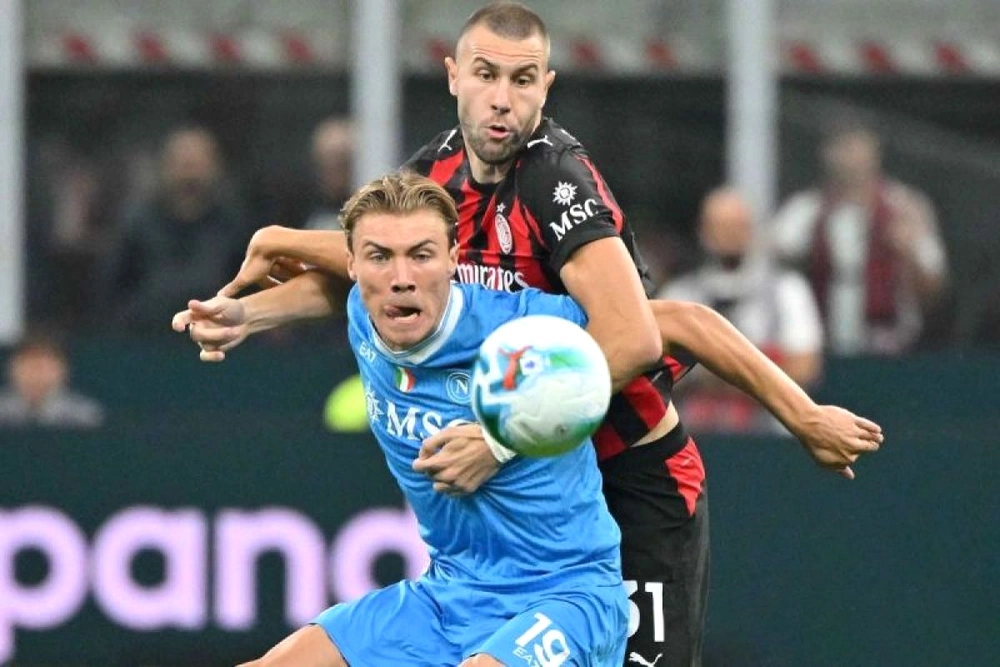
Milan and Napoli this season have played too pragmatically
There are at least three main reasons leading to this decline. First, the quality of attacking players currently playing in Serie A is not high. The entire league has fewer than 5 strikers considered to be of top caliber, and none are among the leading stars. Second, the prevalence of a three-center-back formation overly focused on defense. More than half of the clubs, including the leading and highest-scoring team Inter, use a 3-5-2 formation. Third, and considered the biggest reason, is the outdated rule regarding how tie-breaking criteria are calculated for ranking in cases of equal points. In Serie A, head-to-head results are prioritized over goal difference or the number of goals scored. This creates a habit of focusing only on the result without needing to score many goals, or in other words, fosters a mentality of fearing conceding rather than craving to attack.
Meanwhile, in the Premier League, Bundesliga, and Ligue 1, the primary tie-breaking criterion is goal difference, motivating teams always to push towards the opponent's goal. European cups and even qualification rounds for international competitions are the same. Italians surely remember that their national team needed to beat Norway by a 9-goal margin in the final round of the 2026 World Cup qualifiers, instead of a 4-goal margin, to compensate for the 0-3 defeat in the first leg.
The lack of a habit of scoring many goals has damaged Italian football at every level, but people stubbornly refuse to acknowledge it.


Wonderfulshortvideo

🗣️ "He's just been intercepted!"


harry kane ballon d’or speech harry kane interview harry kane acceptance harry kane instagram

Struggling to stay under my salary cap on @CLUB

User PANDATV has posted a video.

“Whistles are sick!”

This was absolute carnage 🤣

Who does Roy Keane think should win the Ballon d'Or tonight? 🔊🏆
 Links
Links
 Contact
 App
App