



Historically rare! The returner, facing match point, penalized for a time violation, directly loses the match.


A dramatic scene unfolded at the ATP 500 Acapulco event on February 27th, where the returner, facing his opponent's match point, lost the match directly after being penalized one point for a time violation.
The returner was penalized for a time violation. The penalty was issued on the opponent's match point, and the result was the loss of one point. Losing this point equated to the opponent winning the match point without any further play. So many coincidences aligned, making this arguably one of the most extraordinary incidents in tennis history.
This rare and unfortunate incident happened to French player Arthur Rinderknech. It was a quarterfinal match between the world No. 63 Rinderknech and the world No. 84 Serbian player Miomir Kecmanovic. Rinderknech lost the first set 3-6, and in the second set, he was down 3-5, entering Kecmanovic's service game to close out the match.
While returning serve, Rinderknech trailed 15-40. After saving two match points, he twice brought the game to deuce. When Kecmanovic earned his fourth match point, he was ready to serve, but Rinderknech moved slowly and was not prepared to receive serve in a timely manner.
In such critical situations, chair umpires typically exercise more leniency in their officiating to avoid becoming the center of attention or unduly influencing the match outcome.
Confronted with Rinderknech's behavior, the chair umpire promptly reminded him to get ready to receive serve. However, the French player verbally acknowledged but unhurriedly walked to the side to grab a towel and wipe his sweat. Witnessing this, the chair umpire decisively issued a warning to Rinderknech.
Since Rinderknech had already received a prior warning, according to the rules, a second warning results in an automatic point penalty. Given that this point was Kecmanovic's match point, immediately after announcing the warning, the umpire called the match over, declaring Kecmanovic the winner.
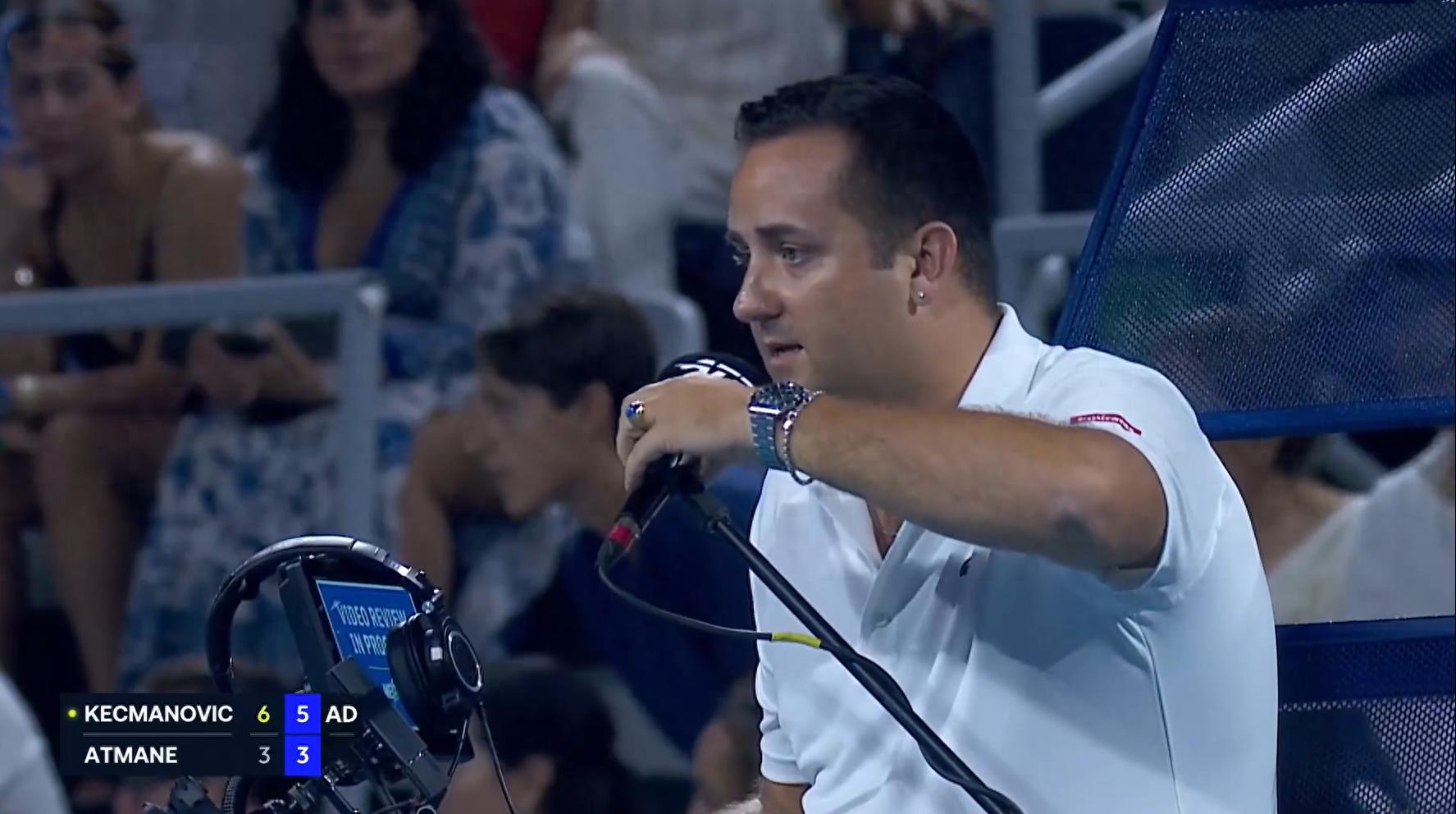
In tennis, the time allowed between points is 25 seconds. The specific rule states that timing starts when the umpire finishes calling the score from the previous point and ends when the server initiates the ball toss. A 25-second countdown clock is usually displayed on the backstop behind the players.
In practice, the chair umpire has some discretion over this 25-second rule. If the previous point involved a very long rally, or if the crowd's applause and cheers persist, the umpire often delays calling the score. This effectively postpones the start of the 25-second clock, allowing both players and spectators a moment to recover.
Experienced chair umpires skillfully utilize this rule to better manage the flow of the match, which benefits both players and spectators. Additionally, if a spectator shouts loudly just as a player is preparing to serve, the umpire will typically ask for quiet, and this interruption time is not counted within the 25 seconds.
Of course, if a spectator repeatedly and deliberately disrupts play, tournament security will intervene, potentially leading to their removal from the venue.
For players on court, we most commonly see servers receiving warnings for time violations. For offenses like smashing a racket, hitting a ball recklessly, or verbal abuse, umpires typically issue warnings. Two warnings result in a point penalty, and three warnings lead to a game penalty. For instance, in the 2018 US Open women's singles final, Serena Williams received a third warning for verbal abuse towards the umpire, resulting in a game penalty.
Unlike the penalties mentioned above, the penalty for a serving time violation is as follows: the first offense results in a warning. Any subsequent serving time violation leads to the loss of the first serve opportunity, forcing the player to proceed directly to their second serve. If that second serve is a fault, it counts as a double fault, losing the point.
Generally, returners are not penalized for taking too long to receive serve. However, if the server is ready but the returner deliberately delays without a valid reason, a warning can be issued. The first offense is a verbal warning. Each subsequent warning for a receiving time violation results in a point penalty, but unlike penalties for racket abuse or aggression, it does not escalate to a game penalty or default.
Returning to the penalty against Rinderknech. It must be said that both the target of the penalty (the returner) and its timing were highly unusual. The convergence of so many coincidences is precisely why this incident has garnered widespread attention.
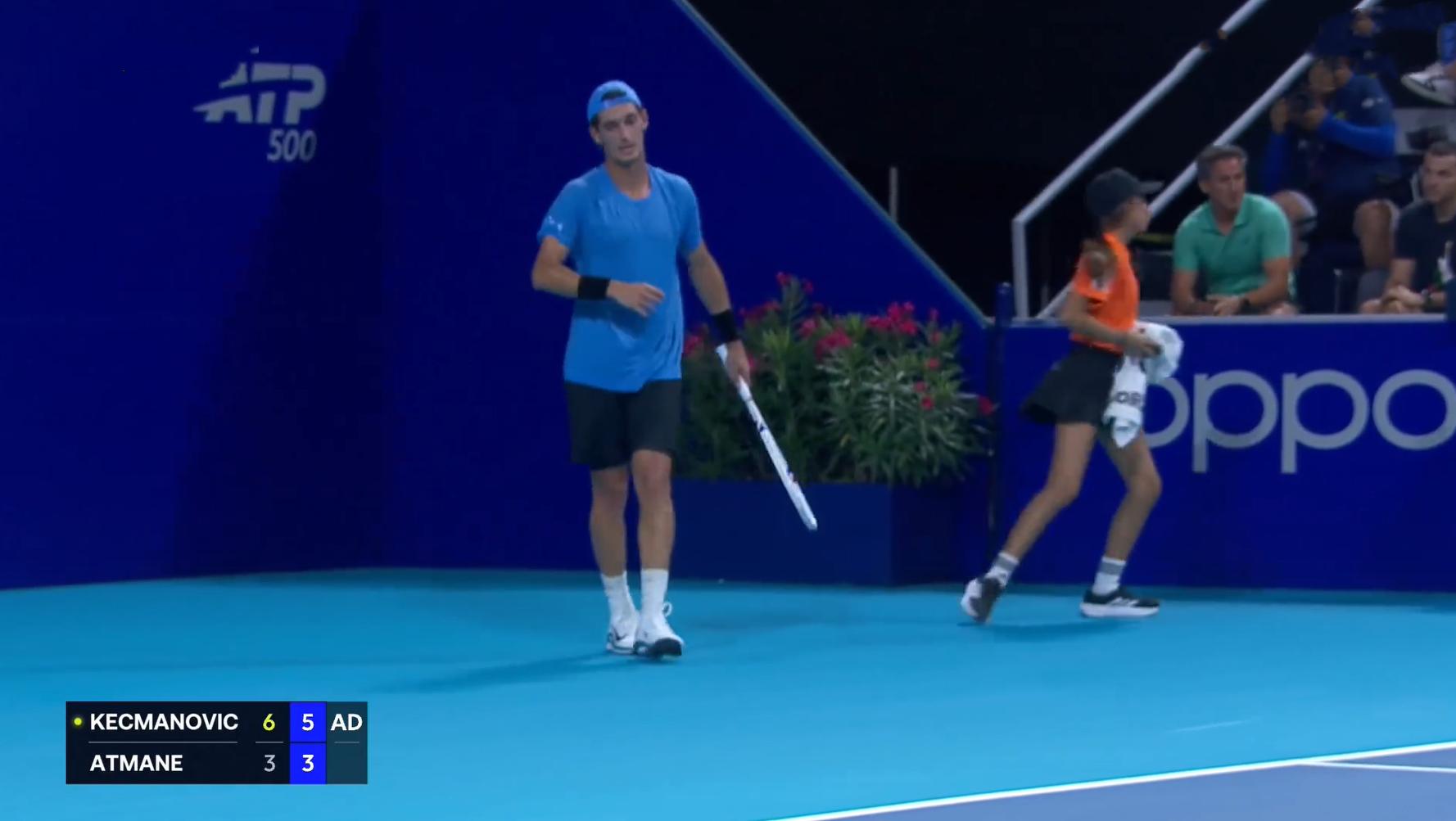
Typically, serving or receiving time violations happen in plain sight for all to see, and the umpire's penalty rarely sparks controversy. After reviewing the replay of this incident, I believe the chair umpire's call was completely correct, and Rinderknech himself appeared to accept the penalty without dispute.
Many spectators believe that Rinderknech getting penalized in this manner was simply his own fault. What are your thoughts on this incident? Feel free to share your comments below.(Source: Tennis Home, Author: Yun Juan Yun Shu)

 Links
Links
 Contact
Address:UNIT 1804 SOUTH BANK TOWER, 55 UPPER GROUND,LONDON ENGLAND SE1 9E
Number:+85259695367
E-mali:[email protected]
 App
App


